Showing posts with label Storytelling. Show all posts

Wednesday, April 8, 2015

Storytelling for Week 12: Savitri saves Satyavan

Savitri went into the forest in search of a man to become her husband because the one's she was being presented were unworthy. As she was wondering in the forest she came across Satyavan. He was the son of a blind man in exile.

As Savitri was approaching Satyavan, Yama, the Death god, came to her and told her that Satyavan only had one more year to live. He questioned if she still wanted to go through with this, but Savitri didn't care. Savitri was love struck. It was love at first sight!

Savitri walked up to Satyavan and said, "Hi I am Savitri. I was sent here to become your wife. Do you accept."

Taken off guard, Satyavan told her that he would have to contemplate the idea first as he had just met her. See, Satyavan wasn't sure if she was an illusion sent by demons or a real woman.

Finally, Satyavan was able to see Savitri's real colors, and the two married.

After one year, Satyavan's time was up, and Yama came to take him away. Savitri was completely devastated about losing her soul mate and decided to follow Yama.

As no one was ever brave enough to follow the Death god to where ever it is he goes with everyone's souls, Yama decided to grant Savitri wishes except she was not allowed to ask for Satyavan back. So, Savitri asked for several things for her beloved blind father in law until, finally, Yama told Savitri to ask for something for herself. However, all she wanted was kids from her husband to that Satyavan's legacy could live on forever. To the surprise of Savitri, Yama said he would grant her Satyavan if she would share her days with him. Therefore, without hesitation Savitri gave them to Satyavan and the couple returned home.

At last, Satvayan woke up after Yama returned his soul to his body, and he felt like the whole thing was a dream. He ran to Savitri and began telling her what happened.

Satyavan said that he was visited by Yama, and he knew immediately it was his time to go. Then, all he saw was the brightest white light and a grand staircase. So, he traveled up the stairs and saw all of his deceased friends and relatives. They all sat around a grand table and drank wine while reminiscing. Satyavan then realized how much he had missed these people, but on earth he had found the sweetest wife, Savitri. He wished he was back with her. That is when he awoke from the sleep and was relieved to see Savitri in the distance. He had no idea what had really happened. 


(Image Source: Savitri and Satyavan by Raja Ravi Varma and A.K. Joshi & co.Bombay) 

Author's Note: I wrote this story about Savitri sacrificing her time on earth for her husband because I found it to be very admirable. Savitri struggled her whole life to find a husband, and when she finally did the man didn't have much longer to live. However, she valued his remaining time and married him anyways. I think this shows the precious act of true love. However, I imagined Satyavan's experience to be much different as Yama had already taken his soul away. Satyavan was already in heaven. He was seeing people that already deceased without being aware of the sacrifice his wife was making on his behalf.  I also found it very peculiar that Yama was so generous with Savitri. Savitri must have been a very courageous woman. She didn't even accept all of the men that wanted to make her their wife in her town. She went out into the forest in hopes of finding exactly what she was looking for. What a brave woman! This picture is a perfect depiction of Savitri protecting her husband from the Death god. This shows the value of a good woman. She provides protection and purpose to Satyavan's life, and he knows it as seen in my creation of his dream.

Bibliography:
  • Buck, William (1973). Mahabharata.


Wednesday, April 1, 2015

Storytelling for Week 11: Milk to Salt

Before the ocean was made of salt, it provided the earth with the creamiest, most refreshing potion known as milk. This potion was worthy of drinking, and so, people would come from all over the land to see and taste this magnificent beverage. It smelled sweet, and looked like a soft blanket of snow like you would see at the top of the mountains where no one has ever walked before. The people had never tasted anything like it! The desire for more made them come back day after day. 

One day, Narayana, an incarnated version of Vishnu, came to the milk sea and shouted to the gods, "Churn the ocean! Unearth the nectar of immorality for me!"

And so, the gods began. They placed the mountain Mandara in the middle. Mandara is the snow mountain, and it is far taller then the sea's depths. Therefore, the milk and snow on the part of the mountain that was visible blended together seamlessly. It was hard to tell the two landscapes apart from one another. However, no one nearby saw this spectacle as the sound of the commotion had pierced their ears, and everyone was hunched over with their fingers in their ears for protection. 

Then abruptly, the great serpent, Sesha, wrapped himself around the mountain and stretched the length of the mountain so that he could be used to churn the ocean. At this moment, Sesha looked like an octopus stretched out to be used in a grand tug-a-war match, good versus evil! Holding onto Sesha's tail were the Asuras which are the unusual-looking, immoral gods. Grabbing onto Sesha's neck were the devas who are the mortal gods including Brahma, Shiva, and Vishnu. Each side took turns pulling back and forth causing the mountain to spin in opposite directions, and of course, messing up the perfect snow on the mountain and throwing boulders into the, now, bubbling milk.


(Image Source: Churning the Milk Sea)

At this, glorious creatures began emerging from the frothing ocean. First, the crescent Moon appeared. Then, to list some of the most notable creatures, Indra's white elephant, Airavata, Surabhi, the white cow who grants wishes, and finally Dhanwantari, the physician robed in white carrying a cup full of amrita, which was the essence of life. 

Narayana screeched with excitement, "At last! I will live forever! This treasure is mine." He had now begun doing his happy dance like a little school girl. Narayana, or Vishnu, was so excited! He proclaimed again, "Thank you, gods. Thank you!"

In the meantime, with all the commotion in the sea from the churning, the sea shot poison up into the air turning the milk into salt water. Milk is a drink that sustains life, and salt water is a drink that destroys it. This was devastating to the people watching.

While the gods were busy elsewhere, the poison shot up into the sky and was going to land all over the worlds. This would instantaneously kill anything that came in contact with it. Miraculously, out of nowhere, Shiva, The Lord of the Mountains and Songs, came flying in to gather all the poison into his mouth in order to swallow it. With this, Shiva saved the worlds. He was a hero!

Unfortunately, the poison was lodged in his airways and his face turned blue. He grabbed the crescent moon that had just emerged from the milk sea and placed it in his hair. With this, Narayana became a woman named Mohini. The cresent moon became a hair jewel for her, and Mohini seduced and confused the asuras who were trying to steal the cup full of amrita. Thankfully though, Mohini succeeded at bringing the devas the armita before the asuras could took it for themselves.       

Author's note: I wrote this tale because I like the significance of the churning of the ocean in Hindu mythology. Also, while writing, I felt like I was able to better understand the events that were happening which helped me to realize why this tale would hold that kind of importance. The beauty of the white milky sea was important in this tale because it is sacrificed in order to bring Vishnu amrita, the essence of life. It is interesting to me that the "dark" gods are pulling against the "mortal" gods like tug-a-war in order to bring Vishnu what he wants. This is very symbolic about the meaning of asking for amrita. When the milk sea began to bring out the glorious creatures, I only named the white creatures that appeared to emphasize the significance of the color white in the story such as, the milk, the elephant, the cow, and the robe. White symbolizes purity so I thought it held a lot of meaning in this tale as the sea was once pure, but now it has been used as a sacrifice and turned into salt water. However, salt is still white. How ironic! I chose this picture because it helps to vividly visualize the event of churning the ocean along with the creatures that surfaced from the ocean during the scene as well. 

Bibliography:  

  • Buck, William (1973). Mahabharata          

Wednesday, March 25, 2015

Storytelling for Week 10: Dhritarashtra Gets Revenge

Once the war was over, the Pandavas decided to return to the city of Hastinapura to inform king Dhritarashtra and his queen of their loss. Yudhistira was the one strong enough to tell Dhritarashtra of the dreadful news. Unlike their cousins, the Pandavas were upset about having to kill their own family members in order to receive justice. Yudhistira tried to tell his uncle of the events of the war as sympathetically as he could. Finally, he concluded with the news about the story of the death of Duryodhana, Dhritarashtra's eldest son. However, he didn't mention the part where Bhima stomped on his body while he was lying on the ground about to die. Unfortunately, Dhritarashtra didn't need to be told about the events because Sanjaya narrated the war as it happened so Dhritarashtra already knew what Bhima had done to Duryodhana. Furthermore, he wanted revenge on Bhima for what he had done to his son! 

Once Yudhistira was done speaking, Dhritarashtra spoke. "I see! And where is Bhima now? I should apologize to him on my son's behalf."

Yudhistira immediately muttered without suspicion, "Well, he is righ...."

Krishna figured out Dhritarashtra's deceitful plan and interrupted Yudhistira. He then presented a statue that he had quickly created that exactly resembled Bhima. 

Dhritarashtra, being that he is blind, embraced the Bhima figure without hesitation and exclaimed, "Alas, I shall kill Bhima once and for all! You fools!" 

With this, Dhritarashtra squeezed Bhima with all his might and left the figure crumbled into millions of tiny pieces on the floor. Moreover, Duryodhana's mother, Gandhari, and Dhritarashtra rejoiced in the thought of revenge for their son's death!

The other Pandava brothers were unaware of the illusion Krishna had presented. They began to weep for all they had experienced had finally been too much for them to bear! The Pandavas grieving only furthered Dhritarashtra's and Ghandri's sweet revenge celebration.   

However, as Bhima watched the spectacle at a distance in the shadows, he was shocked by the actions of his uncle. He couldn't believe his uncle wanted him dead. It broke Bhima's heart as Dhritarashtra celebrated what he had thought was the end of Bhima. With this feeling festering inside him, Bhima abruptly emerged to Dhritarashtra wiping his revenge smirk off his face.

Bhima shouted, "How dare you praise my death, uncle! You traitor."

Bhima attempted to attack Dhritarashtra, but his brothers stopped him. As Bhima was so strong, it took several brothers to actually prevent Bhima from hurting Dhritarashtra. 

While attempting to stop Bhima, Arjuna whispered in Bhima's ear, "Don't waste your time on him. We have already won, brother!"

Bhima grinned and told Dhritarashtra, "Your actions have betrayed us, and therefore, your karma has caught up to you. You failed, and now.... now your kingdom is ours! You have failed once and for all!"

Finally, the Pandavas cheered! They shared hugs and smiles. Dhritarashtra had betrayed them and he deserved to be stripped of his crown. Once Dhritarashtra had failed at his last attempt at killing a Pandava, there was a ceremony for Yudhistra's coronation. Hastinapura's people were actually relieved to have the Pandavas as their new rulers as they were more just.  At last, the Pandavas ruled the kingdom for many years to come without any problems from Dhritarashtra.


(Image Source: Bhima and Duryodhana)

Author's Note: I wrote this story because when Bhima finally defeats Duryodhana it is my favorite part in the book. However, it is ironic how Dhritarashtra wants revenge on him when the entire audience is happy that the evil cousin is finally dead. Furthermore, Krishna plays such an important role in the war between the cousins. However, when choosing between Krishna or one million troops, Duryodhana thought that Yudhistira was silly for choosing him over the numbers. This tale illustrates yet again another moment that Krishna was an asset to the success of the Pandavas. Krishna uses his wise judgment on Dhritarashtra and protects Bhima one more time! Throughout the book the Pandavas are always stunned at the way their cousins and uncles treat them. I used this to display how I thought Bhima would respond to seeing his uncle think he crushed him to death. Furthermore, Bhima is utterly shocked. However, the Pandavas have better characters than their cousins, so they finally rejoice in their victory instead of killing Dhritarashtra as well. I chose this picture because I think this is the main reason why Dhritarashtra wants to crush Bhima, and he doesn't try it with the rest of the Pandavas.  

Bibliography: 

  • Narayan, R. K. (1978). The Mahabharata.

Wednesday, March 11, 2015

Storytelling for Week 9: Arjuna the Hero

One training exercise Drona made the boys do was disrupting their vision and forcing them to try to bow down a bird soaring in the sky. Four of the brothers attempted the exercise but failed miserably at their first attempt. However, Arjuna only took one shot at the narrow image of the bird, and the bird came tumbling out of the sky. This was when Arjuna was named the weapon master of the 5 brothers.

After several months, Drona had finally completed training the Pandava brothers. Drona decided to take a relaxing break by a river when all of a sudden a crocodile attacked him. The crocodile was fierce. It attacked Drona so quickly, Drona didn't even have time to react. The crocodile dragged Drona into the water. It twisted and turned in an attempt to break Drona's neck. 

Drona screamed in terror, "Arjuna! Help me! Save me!" 

Immediately, Arjuna, being just named the weapons master, sprung into action eager to practice what he had just been taught. Arjuna quickly located his bow and ran to Drona's aid! 

Arjuna replied to Drona, "Don't fear! I am on my way! I had to grab my bow first."

Meanwhile, the crocodile had nearly managed to rip Drona's arm off when Arjuna pierced the crocodile in the back. Unfortunately, Arjuna didn't know the shield a crocodile possessed on his back. To kill a crocodile there is one spot that must be hit in order to kill them. There is no other way.This spot is considered the sweet spot. 

Arjuna wasted 3 extra bows until finally Drona shouted at him, "Arjuna he has a sheild. The crocodile is hard as stone everywhere except his head. That's why I can't wrestle myself out of this. Hurry! He is going to kill me!" 

Finally, Arjuna placed an arrow right between the crocodiles eyes. The crocodile realized his monstrous grip on Drona. Drona swam to shore and hugged Arjuna. He had saved his life!

Drona chanted, "Arjuna you are the god of weapons. I will forever be in debt to you for this favor! I am not sure how I will ever be able to repay you for this wonderful thing you have done."

Arjuna responded with, "Drona, you are my teacher. You will forever have my protection. There is no need for you to repay. I will always save you and others out of gratitude for the lessons you have taught me. These skills with help me and my brothers throughout our entire lives. We are eternally grateful. It is the least I can do." 

And the pair walked away together while embracing each other, appreciating the presence of the new friendship that had been made. 

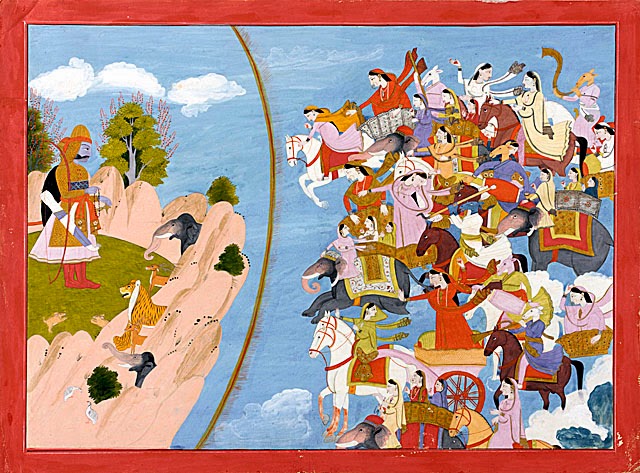
(Image Source: Arjuna by Kangra)

Author's Note: I wrote this story to describe the events that were happening during Drona's attack by a crocodile. I imaged that once Drona was done training the five brothers, he would need a little time to be alone. This is when I envisioned the crocodile attack to occur. Since Drona was alone. it took Arjuna some time to come to his aid. Since I know that crocodile's have a protective shell all over their body except for around their head, I assumed that Arjuna would try to kill him around the heart. While trying to get away Drona learns where to kill the crocodile, and shouts out to Arjuna the key to defeat him. I chose this image because I feel like it shows how powerful of a being Arjuna becomes in his lifetime. This event was just the beginning to great things to come while Arjuna exist. I think this would be a great story to add to my portfolio to give variety from a new source other then The Ramayana. Also, it shows the relationship between the teacher and his trainees. The trainee feels great gratitude to the people that teach them valuable skills that help them to succeed throughout their entire lives.

Bibliography: 
  • Narayan, R. K. (1978). The Mahabharata


Thursday, February 26, 2015

Storytelling for Week 7: The golden Sita

Once the last person of Ayodhya  was left, he began to wonder about what would happen to Rama's beloved golden statue of Sita. The person began to try to place it somewhere safe so that it would withstand the storms and changes of earth without it's people protecting it. However, finding the perfect location was the hardest part.

The person searched high and low and finally found a good place in the palace to store her. He placed the statue there and felt at peace about leaving this earth. And so the final person of Ayodhya died in peace and Rama's kingdom was no longer.

Moreover, the statue of Sita swooshed around and transformed into a brand new animal that Brahma had created. It was a mixture between a squirrel, a monkey, and a bear to symbolize the creatures that assisted in saving Sita from her captured state.

The animal traveled to the kingdom of Surgriva as to be with people of his own kind, but he was shunned because he wasn't completely similar to him. Next, it traveled to the squirrels village, but he was entirely too large to fit in with the squirrels. The squirrels were afraid that this creature would stomp and smash them all to death on accident. Finally, the sad creature traveled to Jambavan's kingdom in desperations hope that he could find a home to live. Although, Jambavan was reluctant to accept him. He began to see the resemblance in Sita. Jambavan had an epiphany and knew this was what was made of Rama's golden statue of Sita. With this knowledge Jambavan created the perfect place for this creature to fit into their kingdom. 

Jambavan called to Surgirva once he had heard that he had denied this creature into his kingdom. However, Hanuman traveled to Jambavan as his messenger to pay Surgriva's respect to this creature of Sita's statue and to apologize for their naive response of him. The squirrels traveled to the kingdom as well, but Jambavan was more understanding to their case of not accepting the creature as he was far too large to fit into their tribe. Once all was aware of the importance of this creature, they all were drawn together for eternity in remembrance of the great Rama and Sita . And so once all was calmed down, all the creature of the forest lived happily ever after while Sita and Rama's legend lived on forever.  

(Image Source: Rama and Sita by Ayan Gupta)

Author's Note: I wrote this story as an explanation of what happened to the golden statue of Sita. I wanted it to be something that would allow the other creatures of the story to know that Sita and Rama's legend would live on forever. Also, it needed to commemorate all the creatures that assisted her during her lifetime. I liked how the creature was so different it was hard for them to accept it into their kingdom at first. I chose this image because I couldn't find one that was the golden statue of Sita. But, it still shows the legend of Rama and Sita lives on forever!

Bibliography:  Buck, William (1973). Mahabharata.  

Wednesday, February 18, 2015

Storytelling for Week 6: A Day as a Cat

As Hanuman stood near the wall protecting Lanka, he knew he couldn't simply climb over it and enter Lanka as a monkey. The demons of Lanka would see him and immediately take the intruder to their king, Ravana. He needed to create a scheme to be able to look around in order to find Sita before he was noticed. 

So, he pondered his options for a moment. He first considered a mouse, but he assumed if someone saw him, they may try to kill the rodent. Things could end very badly. Then he considered a bird. Yet again though, he recognized the flaws in becoming this creature as well. As a bird, he would have to view the city from the sky. He wouldn't be able to spy as well as he needed to at such a distance away from the demons of Lanka. When finally it hit Hanuman, he will transform himself into an innocent cat and enter at night. No one would suspect a thing as cats are known for snooping around at night. His plan was perfect!

As night drew near, Hanuman had to practice transforming into a cat because he was using a new power he was unfamiliar with. However, on the first try he was successful. Hanuman was surprised by how strong his powers were. He knew he possessed some powerful talents, but tried not to become overwhelmed by this thought. All he wanted to do was use them to serve Rama. 

Once a cat, Hanuman felt uncomfortable as he had never transformed into a different animal before. He walked awkwardly on all fours and practiced his meow. Then finally the sunlight vanished and it was night. Hanuman looked around for the guards of Lanka by the wall. When the coast was clear, he jumped over, and began searching for Sita. Anyone that saw him didn't think a thing of the nomadic cat.

While wandering the streets of Lanka, he noticed how peculiar everything looked as a cat. He was enticed to play with balls of yarn and strings he saw in some of the demons' homes. This distraction felt bizarre as these were never items of entertainment as a monkey. Nonetheless, he worked hard to stay focused on the task of discovering Sita for Rama. However, Hanuman felt overwhelmed as the city was the largest land he had ever came across. But still, he stayed fixated on his goal and assumed this was due to the small stature he had taken as a cat. He crept into all the houses and began to lose hope, when finally he discovered a grand palace positioned at the furthermost point of the city. He knew the palace had to belonged to Ravana. 

As he had looked everywhere, Hanuman went into the palace in desperation of seeing Sita. However, all he saw was a room full of beautiful women that were under Ravana's trance. They were sprawled out on the floor surrounding Ravana. in disappointment, Hanuman knew Sita wouldn't be in Ravana's room as she was loyal to Rama. However, as he was a cat and not feeling as himself, he felt mesmerized by every girl's beauty and spent time being infatuated with every one of them. Finally, Hanuman caught a glimpse of Sita outside the window in the garden. This helped him to snap out of his daze of the other beautiful women. Remembering his mission, he rushed to the garden to speak to Sita.

(Image Source: Hanuman and Sita)

Author's note: I decided to write about Hanuman's experience as a cat in Lanka because I love animal character, and I love cats. I tried show a difference in Hanuman's character as a cat compared to a monkey. As a monkey, Hanuman is very dedicated to Rama. He is devoted to his mission. However, as a cat, I thought he could become a little distracted as cats are such playful animals. Also, I wanted to create a moment of pondering for Hanuman to show the readers how he decided on becoming a cat instead of any other animal. It displays his reasoning for his decision. I choose this picture because at the end of the story Hanuman goes to speak with Sita, and also because I couldn't find a good picture of Hanuman as a monkey that I was able to use. This story was pretty straight forward. Hanuman was on a mission to search through Lanka to find Sita, and he accomplished this by transforming into a cat. As we know, Hanuman is a very powerful character in The Ramayana, and I tried to tell the readers that transforming into other animals was an unfamiliar power that Hanuman possesses. What an amazing creature! He can grow to be a giant size, he can jump further than any other animal, he has eternal life, and now he can transform himself into different animals.

Bibliography: Buck, William (1976). Ramayana: King Rama's Way.

Wednesday, February 11, 2015

Storytelling for Week 5: Monkey Kong

Once upon a time in a far away land, Brahma, the creator of life, came down from the heavens to enjoy the magnificent Mount Meru. Mount Meru was covered with gold and diamonds. Everything sparkled. Brahma, overwhelmed by the scenery, shed a tear of joy, and where it landed grew Earth's first monkey, Riksharaja. Brahma stayed on Mount Meru so that Riksharaja wouldn't be left all alone. The baby monkey danced and played on the mountain while eating all kinds of delicious fruit until one day while drinking from a lake, he became bored of the same old thing every day. He began to wonder how much fun the fish below the water were having, since they were swimming around so carefree. 

Suddenly, Riksharaja cannon-balled into the water, making an enormous splash. Riksharaja was enjoying the refreshing water that was swooshing by his fur, tingling his skin for the first time, when he realized his appearance was now that of a girl. So the monkey rushed out of the water and scurried to Brahma to figure out what was the matter with him. Brahma told him that being the only monkey on earth he could act as both a girl or a boy. Surprised, Riksharaja hurried back to the lake and jumped into the water again in an attempt to turn back into a boy, but once out of the water the monkey saw its reflection. She was the most beautiful creature on Mount Meru, and she began to accept her new image.

Meanwhile, Indra, the storm god, and Surya, the sun, caught a glimpse of the breathtaking creature standing at the edge of the lake. It was love at first sight for both gods. First Indra came to embrace Riksharaja, and then Surya came to her second. Within that same day, Vali and Sugriva were born. Vali was Indra's son and Sugriva was Surya's son. Proud of her accomplishments, Riksharaja rushed to Brahma to show off her babies. But before she could make it to Brahma, Riksharaja  got swept off her feet by a whirl of wind. It spun her around so fast she thought she was going to be sick, but all she could think about was the safety of her babies. At last, the wind placed her back on Earth, but now she was in her original form. The sudden gush of wind had turned her back into a boy. Riksharaja, stunned by the day's events, quickly grabbed his babies and continued to run to Brahma, but now it was for safety. 

Riksharaja reached Brahma in such a commotion it took him a while to recognize the gifts Riksharaja had brought to him. Once he saw the babies, he celebrated the monkey's accomplishments and comforted him, as he knew what events had taken place in Riksharaja's day. As a reward, Brahma gave Vali, Riksharaja's son with Indra, the land of Kishkindhya and populated the kingdom with more monkeys so he wouldn't be all alone. Riksharaja had accomplished his purpose on Earth and Brahma allowed to go with him to the heavens to rest. From afar, Riksharaja watched his boys. He began to notice that Vali was spoiled, and he asked the Wind God, Vayu, to have a child that could be a loyal friend to Sugriva. Vayu agreed and went to Kishkindhya to find a mate. Vayu stumbled upon the most beautiful monkey of all, Anjana. While Anjana was alone in the meadows, Vayu made a baby with Anjana.


(Image Source: Hanuman Statue)

Within that same day Hanuman was born. The heavens sang of joy because they knew what kind of steadfast monkey had been born on that day. Unfortunately, Anjana was already married, so she rushed back to her husband in shame, leaving baby Hanuman all alone. Several days went by, and Hanuman grew very lonely. He had to teach himself how to walk so he could survive. 

Once Vayu saw his baby had been abandoned, he tried to visit, but Indra knew the destiny of Hanuman was to be the loyal friend to Sugriva which would somehow result in the death of Vali, his son. Therefore, Indra made it impossible for Vayu to ever be able to come near Hanuman again. As a result of this betrayal, Hanuman became very angry. He made a promise to himself to be the most loyal monkey to ever walk the Earth. Seeing that Hanuman was struggling with the abandonment of his dad, Vayu, Brahma came to his aid as Hanuman had been a faithful creature to the gods. Instead of turning his anger into evil, he used it for good by promising to be a faithful friend to all who deserved it. Brahma granted him everlasting life, and the gods came from all over to teach him powers that would sustain him during his life. 

Hanuman's favorite power was the ability to grow into a massive monkey that could take one step across the ocean. He lived in the forest for four years, scavenging for his own food and befriending a kingdom of bears. One day, Hanuman decided to cross a lake where he found Kishkindhya. He noticed that the creatures of the land were of the same species as himself, so he entered the city in hopes to find companionship among his own. Unfortunately, while Hanuman was roaming the forest, Indra came to Vali in order to warn him of Hanuman's arrival. He told him that by being friends with this creature it would eventually result in his death. Furthermore, once Hanuman came into the kingdom, everyone immediately shunned him due to the orders from Vali, their king. 

However, there was one lonely monkey, Sugriva, that took Hanuman into his home as his long lost friend. Hanuman asked Sugriva, "Aren't you scared of what Vali might do to you if he finds out about my presence?" Sugriva answered, "Don't worry! I will handle my brother." Then Hanuman vowed to be Sugriva's truest friend as long as he should live due to the sanctuary he had just granted him. And so, they both never felt lonesome again, and the pair became inseparable ever afterwards. 

Author's Note: I wrote this as a bedtime story for a baby monkey. I wanted to give it the details that would make it fun to read for a little monkey, so that he will stay interested in it even though it is long. Also, the child might fall asleep before it was over. When I was younger, I loved to have a story to continue the next night. It forced my parents to read to me twice! Also, I added some magical events, such as the spinning wind transforming Riksharaja from a girl back into a boy, so it would have the feel of a fairy tale even though the basis of the story is the real history of Hanuman. This will allow the monkey parent to teach their baby monkey a little bit about its history while being entertained. However, once Hanuman was born, I wanted to continue his story to show what a great character had been created for Surgriva.  As we have read, Hanuman is very loyal, and I wanted to provide a story that explained what made this monkey so loyal to Sugriva and Rama. I displayed this by adding the details about how Hanuman used his anger for good. I choose the image above because it gives an image of Hanuman to place with the story about his birth that is being told. Unfortunately, I was unable to find a picture of baby Hanuman. I think this will be a great story to put into my portfolio because I enjoy reading it and I hope you do too!

Bibliography: Buck, William. Hanuman. Ramayana: King Rama's Way. (1976): 184-189

Wednesday, February 4, 2015

Storytelling for Week 4: The Beauty and the God

Brahma created thousands of ordinary creatures called man. Once he saw how helpless they were alone, Brahma created enough women that every one of these men could have a woman of their own. However, when Brahma was creating the last woman, he grew very fond of her and took his time with every detail of her body. As her creator, he wanted the gift of naming her. Brahma thought long and hard on what her name would be when he finally decided on Ahalya, meaning "one with an impeccable beauty." It was only fitting that her beauty went along with this beautiful name. Alas, Brahma was ready to bless the world with his masterpiece, but Indra was lurking near and creating a master plan to dishonor her beauty. Furthermore, Brahma wanted her to live as a normal person with the man he created her for, Gautama, and among her own kind. Hence, to avoid Indra, he strategically placed her near Gautama and a great distance from Indra. Therefore, Indra didn't get the opportunity to meet her before Gautama and Ahalya were already married.

Meanwhile, Gautama was patiently waiting on Brahma to create his very own woman, as everyone else in his world had already found their mate. Gautama waited for his one and only while diligently praying to Brahma to bless him when he found timely. He knew that his faith would bring him what he needed in Brahma's time.

Finally, Gautama laid eyes on Ahalya. It was love at first sight for him. However, Ahalya just went along with the arrangement because no one else was available. As time went on, she grew to love Gautama. However, Ahalya was always stared at and complimented by everyone she came across. This created a great deal of curiosity for Ahalya about different experiences.  Gautama saw the doubt in Ahalya's eyes, and moved the couple to the countryside so that no one would tempt her any longer.

Finally Indra arrived in town, but the townspeople told him about Ahalya's marriage to Gautama. Also they mentioned that the two had already gone to live in the countryside in hopes of secluding Ahalya from other people in the world. Indra panicked and whispered to himself, "I am too late." Ahalya, his infatuation, was already married and living happily ever after in peace. Unfortunately, Indra still lusted for Ahalya. And so, Indra was determined not to give up until he saw the marriage for himself. So he searched high and low for the beautiful Ahalya. As time went on Indra, the king of storms, grew frustrated. His emotions created a rainy period that wouldn't cease until he found Ahalya. Alas, he stumbled upon their modest cottage in the mountains. He saw the couple cooped up in the cabin waiting on the storm to pass. Forgetting about Gautama, Indra became mesmerized by Ahalya's beauty. He then decided she would be his, even if it was just for a moment. After all, Indra was the god of storms, and he knew just what to do to get rid of Gautama long enough for him to be alone with Ahalya. 

The next day, Indra made the weather clear up. Gautama went to the river to meditate and bathe just as Indra had hoped. That's when Indra took advantage of his chance to meet Ahalya. He rushed to the front door as soon as Gautama was out of sight. But suddenly, right when Indra was about to knock on the door, he remembered they had no neighbors. Ahalya would simply be scared of a stranger's visit. Indra quickly decided to disguise himself as Gautama in order to meet her. Upon entering the cottage, Ahalya's presence was too overwhelming for Indra, and he decided to take what he had wanted from her quickly before Gautama returned.

Afterwards, Indra had an epiphany and felt guilty for deceiving such a beautiful woman. He rushed out of the cabin in a daze and quickly got rid of the disguise. Though, as Indra was leaving, Gautama was returning from the river and caught a glimpse of Indra. Gautama knew what had happened and cursed Indra by castrating him for taking what didn't belong to him.


(Image Source: Kali, Indra, Brahma, Vishnu, Shiva)

Author's note: I chose to write the story of Ahalya from Indra's perspective because I wanted to display how deceiving the gods seem to me. This creates my question: How is a woman to remain pure if a god could deceive her by using disguises? While reading this story in The Ramayana, I didn't feel like Ahalya was totally convinced that Indra was Gautama. However, in fear of possibly denying her husband, she allowed it to happen anyways. I felt as though this made her seem curious because she saw through the disguise but still allowed it to occur so I portrayed her in this way in my story. Indra is a fascinating character. It seems difficult to be a woman of good virtue when in these times a woman had to fear being tricked by a god even though he was disguised as her very own husband. How are women ever to be sure they are allowing the right man to touch their bodies? This would create a great deal of fear for me if I had to worry about catching others in disguises that are trying to fool me. I choose this image because it displays several gods that I feel a mortal has to be careful around. A person may never know when they are being deceived. This is an interesting topic to use in my portfolio because it displays Indra's dynamic personality. 

Bibliography:  

  • Buck, William, "Taste this Water", Ramayana: King Rama's Way, (1976): 51-52.
  • "Ahalya", Wikipedia. web. 


Tuesday, January 27, 2015

Storytelling for Week 3: Captured

When he arrived at Lanka, Ravana introduced Sita as his new mistress. However, Sita scoffed at the sound of this comment, which made Ravana's wife and other mistresses wonder about the truth behind this abrupt announcement. Ravana decided Sita's arrival deserved a celebration of her. So the citizens decorated the town with fancy colors and lighting. Also, the rakshasis danced around her and praised her beauty because Ravana ordered them to. Once the citizens had a chance to individually greet Sita, those who could afford it showered her with extravagant jewels for their new queen. Not amused by the events, Sita refused them all, drawing attention to the fact that Ravana had actually kidnapped her and she was there unwillingly. Because of Sita's actions, Ravana was forced to tell those close to him how he had actually obtained her. Ravana was annoyed by her behavior, and due to Sita's unappreciative acts, he sent her away to Ashoka Vana, imprisoning her in hopes of convincing her to reject Rama and accept Ravana as her husband. Ashoka Vana is a pleasure garden; it was supposed to be a joyful place, but Sita's experience in this place was often accompanied by Ravana trying to force her to be his wife.

Meanwhile back in Lanka, rumors among the common asuras flew around town like wildfire. Some believed in their king's purity, preaching, "Ravana wouldn't steal a woman without her will. She must be shy." However, others questioned his intentions, asking, "Would Ravana really steal another man's woman? Why else would she be so standoffish to her new kingdom?" They couldn't imagine any other reason why a woman of such beauty would be so ungrateful. Queens wouldn't deny the gifts from her people, especially at the introduction celebration. Unfortunately, the citizens had to make assumptions about Sita as Ravana never exposed his truths except to a selective few, whom he knew wouldn't turn on him.

As time went on, day after day, Sita grew lonely and increasingly exasperated at her situation. She wondered and wished for the day that Rama would arrive for her rescue. Suddenly, Ravana entered shouting, "Well, you miserable woman, have you decided who your true prince charming is?" 

She responded without hesitation, "My beloved Rama is searching for me, and when he arrives you will be sorry." 

This angered Ravana and he responded in rage, "You foolish woman, it will be you who are sorry!" Then Ravana stormed out. Every day after this encounter, Ravana came to visit Sita, making threats towards her and Rama. His threats promised Sita that he was going to destroy Rama. When Ravana wasn't near, Sita pleaded with the rakshasis who were guarding her. The rakshasis, unfortunately, remained loyal to Ravana despite feeling sorry for Sita when they looked at her.

Meanwhile, Mandodari, Ravana's first wife, tried to figure out Sita's past and her intentions for the future. However, Ravana kept a good secret! Just when Mandodari was losing hope, Hanuman arrived in Lanka seeking the site of Sita and to inform Ravana that Rama was coming for him. Once Mandodari heard the news, she decided to make a visit to where Sita was residing. In the middle of the night, Mandodari sneaks to Ashoka Vana unnoticed. She startles Sita and tells her about  Hanuman's arrival in Lanka. 

Mandodari says to Sita, "My husband Ravana told me that he found you injured and saved you. I do not understand why you are acting so ungrateful. Do you know who Hanuman is?" 

To the surprise of Mandodari, Sita already knew of Hanuman's presence as he has already visited her, and Sita responds, "I was not saved by Ravana. He kidnapped me! Hanuman is here to tell Ravana that my husband, Rama, is on his way to rescue me." 

Mandodari, in tears, leaves Sita after hearing the truth about Ravana. She also fears the safety of her city.

Furthermore, while Mandodari was away, Hanuman was making his exit known in Lanka by burning the capitol to ashes.


(Image Source: Hanuman giving Sita Rama's ring by Soham Banerjee

Author's note: I chose this story because I am hoping I could put it into my Portfolio to give an event about the great character, Sita. Ravana kidnapped Sita, and she is shown as a damsel in distress. I want to highlight what Sita could be doing while waiting on Rama that could be of some assistance when he arrives to rescue her. I, also, imagined Mandodori, Ravana's wife, as being curious about the threat of  her position as Ravana's favorite wife by Sita's arrival in Lanka. This is why I wrote about Mandodari coming to Sita to figure out her intentions. However, Mandodori thought she was waiting on Ravana to decide if Sita was going to be his new wife. Furthermore, little to Mandodori's knowledge, Sita wanted nothing to do with Ravana, and was desperate to return to her husband, Rama. The pure avatar of a goddess never posed a threat to Mandodori or the asuras. She just wanted Rama. Ravana was the one that was holding her against her own will. However, he was telling Mandodari a lie to make her position feel threatened. I chose this image because at the end of the story Hanuman had already visited Sita, and during this visit Hanuman gave Sita a gift of good faith from Rama, his golden ring. The token of love is what gave Sita the courage to tell Mandodari what was really happening with Ravana.

Bibliography
  • Narayan, R. K. (1972) The Ramayana.

Wednesday, January 21, 2015

Storytelling for Week 2: Kaikeyi fears her future

After Kaikeyi talks with Kooni, she finds herself having a panic attack about her future. She decides she is going to spend her night in the Kopa Gruha. The Kopa Gruha is a room where Kaikeyi goes when she has fallen into an ill mood. Kaikeyi knows that when the king learns about her whereabouts he will come looking for her. As she is alone in the Koba Gruha her mind begins to race about her future and what the best possible scenario is in order to correct it. She comes to the conclusion that she has no choice but to force the kings hand in crowning her own son in order to remain royal. As very common for a woman, she begins to act out the scenarios of how the King, Dasaratha, is going to take her plans for the crowning of Bharata instead of Rama. She begins by asking Dasaratha, "Why didn't you tell me your plans before you began making the arrangements? It would have been nice to hear of the ceremony from you instead of the people of the kingdom. I am the queen still after all, am I not?" Dasaratha replies with his apologizes but she doesn't care to hear them. She moves on to ask him, "What made Rama more worthy then my son? Am I not worthy enough?" Then she imagines his reply. "Rama is more fit for King. He went out into the woods with Visvamitra and destroyed God's. He will protect this kingdom. I trust him." In which she replies, "But my son has been with my father learning the traits of being a king. He possesses all the required qualities to rule a kingdom as well!" She imagines Dasaratha response, "Well I am more fond of Rama. He is my eldest son and he has made me very proud." With this Kaikeyi gets angry! She assumes Dasaratha is also more fond of his first wife, Kausalya, due to these comments. She then hisses, "Well remember when you promised me those two promises? I want to use them now!" With this Dasaratha will become irate she imagines. She knows he is going to know what she is up to. She continues, "I want you to exile that adored Rama, and make my son the king of Ayodhyra, so that I will remain in my rightful place at the top." With the thought of saying this greedy remark to Dasaratha, Kaikeyi begins to cry. "Exiled!," she whispered to herself. This greedy feeling that has overwhelmed her is against her character, but she is so fearful of her future. She sees herself slowly drifting out of wealth, and the kingdom praising Kausalya instead of her. She is frightened. She imagines it won't happen immediately, but she is scared of the long-term effect for her in crowning Rama instead Bharata. She has always been accustomed to being praised and being blessed with all the luxuries of the world. While being so obsessed with her well-being, she has forgotten how Dasaratha is going to react to her earth shattering news. She then imagines that Dasaratha will leave her, but reassures herself this won't matter once her son is king. He will be so overwhelmed with gratitude for her, he will make sure to take care of her as an effort to return her favor in making him the king. She never imagined that her request was going to kill Dasaratha. She even thought she was doing what was right for her son not just herself. However, even Bharata becomes appauled by her and shuns her because of her greedy behavior. Now she is going to end up worse then she could ever imagine because of her actions.  After this drama, Kaikeyi became so exhausted with her emotions. She found herself limp laying on the floor, where Dasaratha finds her later that night. Furthermore, even though Kaikeyi thought she was helping her and her son, she was solely focused on her future. Greed can be a detrimental factor of any relationship. Always take a step back and analyze your actions to ensure you aren't only concerned about your own outcome.

 (Kaikeyi laying on the floor in the Koba Gruha when Dasaratha finds her
photographed by Ravi Varma Press Kaikeyi in Koba Gruha)


Author's note: While reading what Kaikeyi did to Dasaratha and Rama, I couldn't help but think how this ugly amount of greed had overcame her. This emotion was so overwhelming, she forgot to step back and realize how she was affect others that she loves. Sometimes when something happens, we all need to stop only considering the outcomes on ourselves. From the stories about Rama's character. I know he would have made sure Kaikeyi was taken care of. She lost sight of what really matter, people. 

Narayan, R. K., Two Promises, The Ramayana, (1972): 41-44. Print

Wednesday, January 14, 2015

Week 1 Storytelling: King of the Jungle

There once was a lion who was preying on a unicorn. When the lion was about to catch the unicorn, the unicorn disappeared into thin air. He had used his magic. The unicorn reappeared standing behind the lion. The unicorn laughed and uttered, "I thought you were supposed to be the king of the jungle." The lion responded in anger, "I am!!" He then proceeded to challenge the unicorn to a contest that would determine who was the fastest, strongest, and smartest of all the animals in the land. The unicorn accepted his challenge without hesitation as he thought he could win. The contest consisted of a race in order to measure the speed of each animal, pulling large branches to measure their strength, and a preying contest to determine who could outsmart the other animal in order to feed themselves and their families. Rumors of the contest spread like wild fire throughout the forest. Animals from all kinds of places in the forest made the trek to be apart of the event. As the animals arrived, they came bringing gifts for the contenders. Some sneaky animals offered the lion and the unicorn unhealthy snacks in order to fatten up their opposition. However, the generous animals brought them both healthy snacks to help the contenders be at their peak conditioning level in order to win. The lion and the unicorn had to be aware of their friends and their foes. Alas, the day of the event had arrived. The lion won the race with ease. The unicorn was no match for the lion in this category. However, the unicorn gave the lion a good scare in the strength event. The unicorn was one log away from beating the lion, but in attempting to beat the lion, the unicorn fell and injured his horn. The contest had to take a break to let the unicorn gain his strength back. During the break the lion was acting conceited, as if the other animals did not deserve his presence. Meanwhile, the unicorn had become irritated by his losing position, and was so unpleasant none of the animals wanted to be around him either. By the time the contest had resumed, the observing animals had created a plan of their own. The only event left was the preying contest which is where the lion's abilities lacked against the unicorn. However, not to the knowledge of the lion or the unicorn, the new intentions of the other animals was to get the lion and the unicorn out of the forest because they both were unpleasant to be around. The animals of the forest accomplished tricking them both into doing the preying contest in a far far away land outside of the forest. So when the lion finally caught the unicorn despite it's magic, the lion was crowned the king of the forest, but no on was around to celebrate and praise him. Nobody likes a lion that cannot win with grace and an unicorn who is a sore loser.

(The Lion and the Unicorn
Author: L Leslie Brooke

The lion and the unicorn

Were fighting for the crown;

The lion beat the unicorn
[63]
All round about the town.


Some gave them white bread,

And some gave them brown;

Some gave them plum-cake,

And sent them out of town.


(Lang, Andrew, The Lion and the Unicorn, The Nursery Rhyme Book, 1897: 62-63 The Nursery Rhyme Book)

Author's note:
I summarized this nursery rhyme into a contest with two dominate animals in the forest with equally powerful strengths. Lions always think they are the best and unicorns have magically powers, so they have a good match up. The town or forest are sick of these animals fighting for dictatorship because the rest of them want to live in harmony. During the fighting for control of the forest both animals get kicked out of the forest. Be a graceful winner and a good loser. Sports teach good sportsmanship which is a good lesson that is useful throughout a person's adult life.